
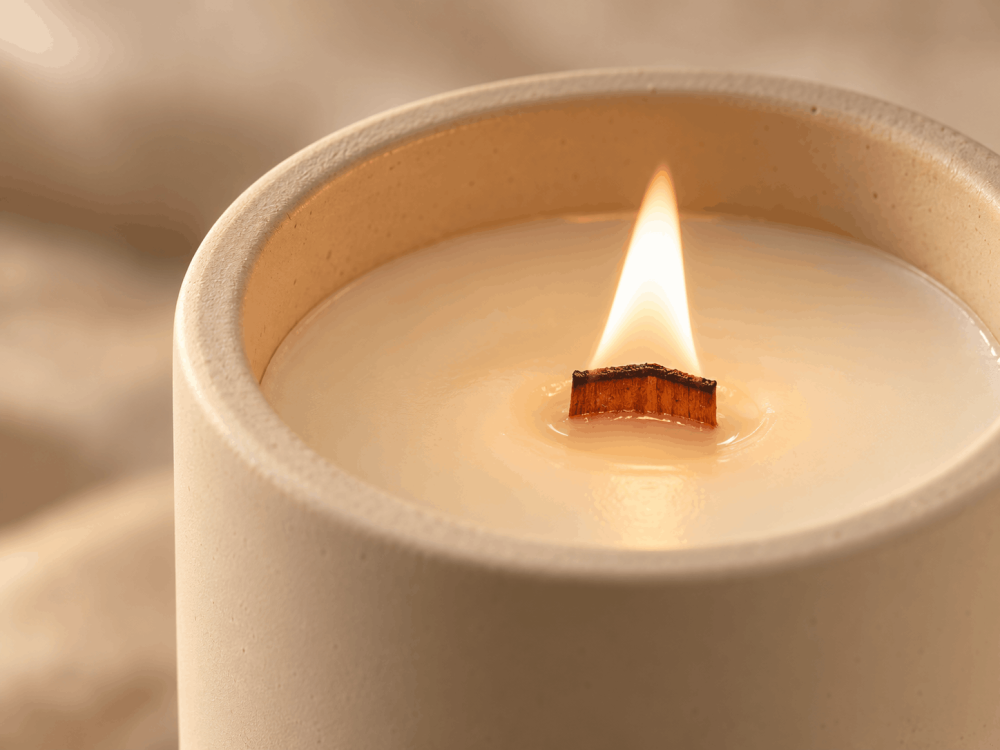
Why RIA Chooses Soy Wax
When choosing a candle, scent is often the first thing we notice. But the candle experience begins long before fragrance — with the wax, wick, fragrance composition, and the way the candle burns.
At RIA, we chose soy wax and use wooden or cotton wicks depending on the design of each candle because we believe quality begins with what goes into the product.
Why Soy Wax?
Soy wax is made from soybean oil, making it a plant-based material, while conventional paraffin wax is mineral-based and derived from petroleum.
Research published in the Journal of the American Oil Chemists’ Society has described soy wax as a renewable and biodegradable alternative to paraffin. [1][2]
For us, choosing a plant-based wax naturally aligns with RIA’s approach to more thoughtful and conscious material choices.
What Does Research Say About Burning and Soot?
In one study comparing soy, paraffin, and beeswax candles, the tested paraffin candles produced noticeable soot, while the tested soy candles produced very little or almost none. Soy wax also showed a slower burn rate than paraffin under the study conditions. [1]
This does not mean every soy candle will always burn cleaner than every paraffin candle, but it shows that wax type can meaningfully influence how a candle burns and what it emits.
The Wick Matters Too
Wax alone does not make a good candle.
At RIA, we use natural wooden or cotton wicks depending on the candle’s size, design, and desired performance. Research suggests that the combination of wax and wick can influence soot and particle emissions during burning. [3]
That is why wick selection and proper wick care are an important part of the candle experience.
Fragrance Is Part of the Formula
Fragrance should not be considered separately from the rest of the candle.
A study evaluating 24 different candle formulations found that emissions can be influenced by several factors, including wax type, fragrance, wick, and the overall candle formulation. [4]
For this reason, at RIA we think about the candle as one complete composition.
Why Do We Prefer Soy?
Soy wax offers a combination of qualities that fits the type of candle we want to create: a plant-based material, a renewable alternative to petroleum-derived paraffin, and encouraging findings in some studies regarding soot and burn rate.
But ultimately, a good candle is never about one ingredient alone.
It is a balance of wax, wick, fragrance, vessel size, and the way the candle burns.
For us, that is what a more conscious choice means: understanding what goes into the candle, why we choose it, and how each detail shapes the final experience.
Scented by Nature. Made with intention.
References
[1] Rezaei, K., Wang, T. & Johnson, L. (2002). Combustion characteristics of candles made from hydrogenated soybean oil. Journal of the American Oil Chemists’ Society, 79, 803–808.
[2] Rezaei, K., Wang, T. & Johnson, L. (2002). Hydrogenated vegetable oils as candle wax. Journal of the American Oil Chemists’ Society, 79, 1241–1247.
[3] Andersen, C. et al. (2021). Emissions of soot, PAHs, ultrafine particles, NOx, and other health relevant compounds from stressed burning of candles in indoor air. Indoor Air.
[4] Salthammer, T. et al. (2021). Measurement and evaluation of gaseous and particulate emissions from burning scented and unscented candles. Environment International, 155, 106590.